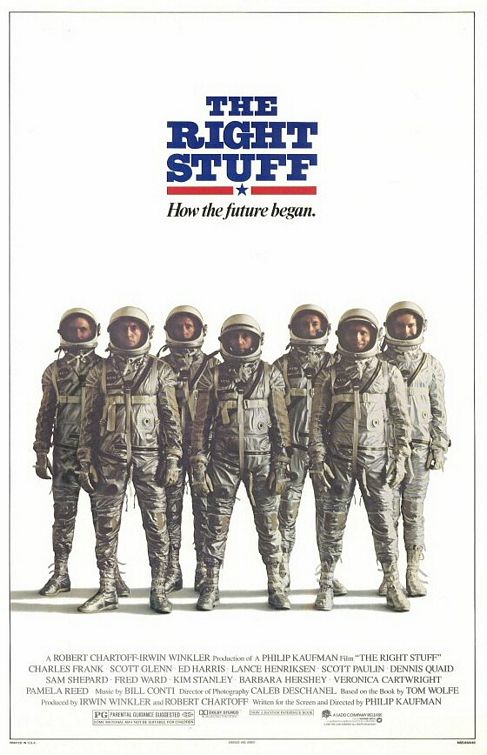
 In class we watched the movie "The Right Stuff". This movie was about the Space race. The two countries that were competing in the space race were the United States and the Soviet Union. This movie took place during the Cold War. For most of the space race the Soviet Union was winning for they were the first country to put a man in space, a week after the United States got an animal up there. They were also the first country to put a satellite in space. But in the end the United States won by getting a man on the moon. The scenes from the film that will make me remember this Cold War event would be when the United States had sent spies to see what the Soviet Union were doing and the drills that the men were doing to get prepared to go to space.
Wednesday, April 14, 2010
Film Lesson: "The Right Stuff"
In class we watched the movie "The Right Stuff". This movie was about the Space race. The two countries that were competing in the space race were the United States and the Soviet Union. This movie took place during the Cold War. For most of the space race the Soviet Union was winning for they were the first country to put a man in space, a week after the United States got an animal up there. They were also the first country to put a satellite in space. But in the end the United States won by getting a man on the moon. The scenes from the film that will make me remember this Cold War event would be when the United States had sent spies to see what the Soviet Union were doing and the drills that the men were doing to get prepared to go to space.

Monday, April 12, 2010
NATO and The Warsaw Pact
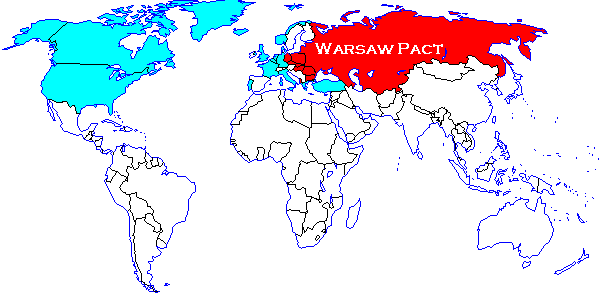
NATO stands for North Atlantic Treaty Organization. It was an alliance of countries in Europe and North America. The Warsaw Pact was another alliance between the Soviet Union and its satellite countries. It was created because of the creation of NATO. Both alliances' stated that if one of those countries' were to be attacked all the other countries in NATO or the Warsaw Pact would go help them out. Both alliances were made for defense reasons. In the picture above, the countries in blue represented those in NATO and those in red were in the Warsaw Pact. NATO was formed because the countries in it wanted a mutual alliance and so that the people in their countries felt safe and not threatened by other countries. The Warsaw Pact was formed in response to the creation in NATO. NATO was formed by the United States, mostly to help other countries and to keep communism from spreading. The Warsaw Pact was formed by the Soviet Union, so that they can spread communism.
Tuesday, March 23, 2010
Film Lesson: "Schindler's List"
 In class we watched the movie "Schindler's List". "Schindler's List" illustrated the Holocaust by showing how Oskar Schindler had helped Jews during a horrific time. It showed how he had helped save them from going into camps, and eventually get killed. He made them work in his factories, which was better since they would live. The scene that was really powerful was how real it looked when the Nazis were killing people for no good reason. The image that would stay with me was when I saw that the girl with the red coat died and when the Nazis lined some people and shot some of them with one bullet, if they didn't die they shot them till they did. Another scene that would stay with me was when a bunch of kids were put into a truck and they were all happy and waving at their parents not knowing what would happen to them. To me "Night and Fog"was more powerful because that film had actual scenes of what happened in the camps and was a documentry so you saw actual dead bodies and how horrible the Nazis treated them.
Film Lesson: "Night and Fog"
 In class we had watched the movie "Night and Fog". It is a documentary on the Auschwitz concentration camp, 10 years after being closed down. It shows some gruesome stuff that changes how people see the Holocaust. It was a very powerful movie and had some scary scenes that made me happy I wasn't alive during that time. While watching this documentary I felt disgust on how the Nazis treated the Jews. My first reaction was horror. I had seen some images and read about what happened in the concentration but I never saw how horrible it really was. I thought this film was very powerful. "Night and Fog" it had more powerful and gruesome than the ones in "Schindler's List". I think "Night and Fog" illustrated the Holocaust better than "Schindler's List" because it showed real video and showed the Holocaust as it actually was.
Thursday, February 25, 2010
The Treaty of Versailles (ended WW I)
 The Treaty of Versailles was a peace treaty signed between Germany and the Allied Powers on June 28th 1919, which ended WWI. The Treaty of Versailles made German life bad after WWI. Germany had to accept full blame on starting the war thus being completely humiliated and initially refusing to sign the treaty. They were to pay for compensation to the allies under Article 231 (the "War Guilt Clause"). Some of their land was taken away, including their colonies, and distributed among the allies. They had to pay a whole lot of money to the allies that when not payed, they would be visited by troops from the allies. Germany did not pay most of it back in money but with coal and other products. The German economy was ruined and being unable to recover itself. The German military and army were restricted. The Germans felt insecure and horrible because they couldn't defend themselves and they had to follow other peoples' rules. I think that treaty was fair yet unfair. I thought it was fair because they did the most damage to the allied powers' military. I thought it was unfair because Germany shouldn't be the only one blamed for the war. I think historians say that the Treaty of Versailles led to the rise of Fascism and Hitler because most of Germany felt insecure, which made them look up to Hitler as a leader that would stop other countries from controlling them.
Wednesday, February 24, 2010
Mustafa Kemal (Ataturk) and the Modernization of Turkey
 Mustafa Kemal (Ataturk) is known for being the first President of Turkey. He modernized Turkey in a very short period of time. He made Turkey more secular. Secular are things that are not pertained or connected to religion. He let people believe in the religion they wanted to believe in. He believed in united humanity and equal rights for everyone. He believed that that the country was drastically not modern. He wanted to modernize Turkey to give it a new sense of dignity, equality, and happiness. Ataturk gave women their equal rights in 1926, with the new Civil Code. He wanted the people of Turkey to start wearing European hats and never to wear the fez. He made women stop wearing veils. He wanted all citizens to have surnames. He changed the Islamic calender to the Western kind. Ataturk also decided to change the nation's language, from Arabic to Latin.
Thursday, February 11, 2010
Film Lesson: "Gandhi"
 During class we watched the movie Gandhi. It was based on the life of Mohandas Gandhi. He was better known as Mahatma in India and for playing a part in the independence of India from Great Britain. He believed in non-violent resistance to get independence. This meant that he wanted the people of India to rebel without violence. He used this by making Great Britain look bad instead of the Indians who were getting hit and not doing anything back. When he saw that Indians were using violence he went on a hunger strike until they stopped. This helped by making Indians not use violence. Gandhi spoke at many gatherings. He told Indians to stop buying Britain's clothes and make their own. He made his clothing by using a spinning wheel several hours a day. He led many marches but the most famous one was the Salt March. Britain was putting taxes on many things including salt. Gandhi led a march from Ahmedabad to Dandi. At the end of the march he made salt.
Subscribe to:
Comments (Atom)